

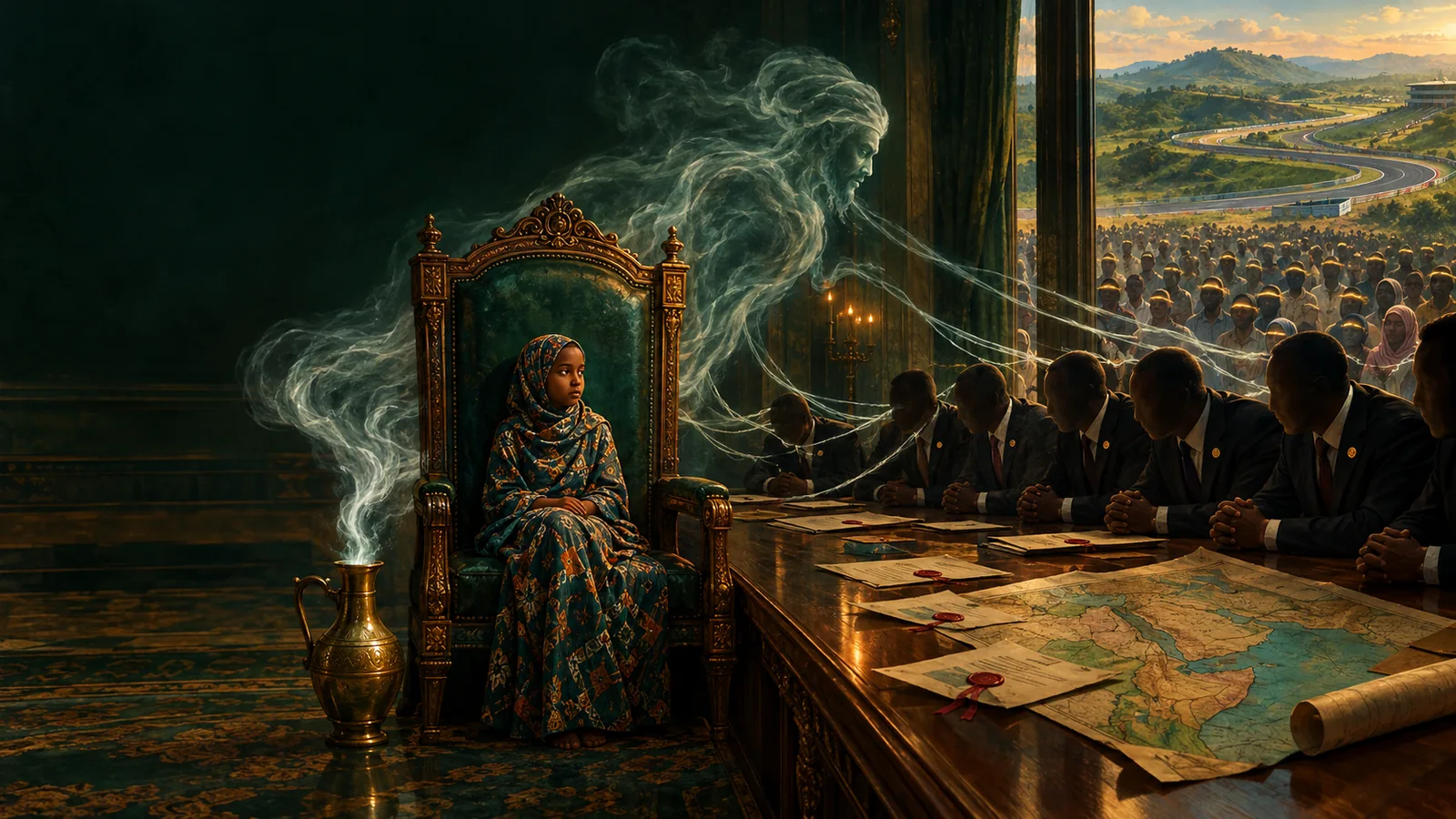
Some stories you read in Form Three because the examiner said so. A few you keep reading for the rest of your life because the country keeps rewriting them in front of you. For me, Saida Hagi-Dirie Herzi's Government by Magic Spell is the second kind.
It is a short story about a little girl, a jinni, and a clan that runs a government. When we studied it for KCSE literature, we treated it the way teenagers treat set texts: themes, character traits, a likely essay question about nepotism. But for me it never stayed on the syllabus. For years, every reshuffle, every appointment that made the country ask "who is this person, and whose?", has sent me back to Halima and her clan. The latest reminder came this October, when half of Kenya was scrolling through Rwanda's Cabinet list and the other half was scrolling through ours.
This post does two things. It introduces the story to anyone who never had the pleasure of being examined on it. Then it holds the story up against Kenya, gently, because satire works best when it lets you laugh first and wince second.
In brief#
Government by Magic Spell is a satirical parable by the Somali writer Saida Hagi-Dirie Herzi. A ten-year-old girl named Halima is said to be possessed by a jinni, and her powerful clan, which has filled the government in the capital with its own relatives, recruits her to keep them in power. Her greatest spell is not a curse on their enemies. It is a cure for curiosity, so that ordinary people stop asking questions about how they are governed. The story was written before Somalia's state collapsed in 1991, and it reads today as a warning about what happens when appointments follow blood instead of ability.
The story and its author#
Saida Hagi-Dirie Herzi is a Somali writer and scholar whose short fiction found its way into some of the most important anthologies of African writing. Government by Magic Spell appears in The Heinemann Book of Contemporary African Short Stories (1992), edited by Chinua Achebe and C. L. Innes, and in Margaret Busby's Daughters of Africa. In Kenya, a whole generation of students met it in the short-story anthology set for the KCSE English literature paper, Half a Day and Other Stories. The BBC also included it in a radio series of stories from the Horn of Africa.
Not much is written about the author online, which is a pity, because she did something difficult. She wrote about clan politics in Somalia from inside the culture, with affection for its beliefs and no patience at all for the people who exploit them.
What follows contains spoilers. If you have the anthology on a shelf at your parents' house, go and read it first. It is short.
Halima and the jinni#
Halima is ten when she falls ill and stays ill for months. The village healer, the waadad, is called, and he finds the cause. One night, outside the bathroom, Halima stepped on an infant jinni. The jinni has taken up residence in her. Fortunately it is a benevolent one, and its parents even come to visit Halima to give instructions on how their child should be looked after.
The village does what villages do with a miracle. They decide that Halima can now see the future and heal the sick. Her family, and then her whole clan, treat her with awe. That awe buys her something rare for a Somali girl of her time: freedom. She turns down every marriage proposal, including one from the waadad himself, which tells you something about where the healer's own interests lay.
The clan in the capital#
Meanwhile, in Mogadishu, Halima's clan is doing very well. The story explains exactly how in a single line: "It had all started with one of their men who had become very powerful in the government." That man found jobs for his relatives. His relatives found jobs for theirs. In about a decade the clan had become the government, and it grew rich. Many of the clan's officials could not read. Anyone who stood in the way was removed.
A government built this way has a problem. It cannot rely on results to keep it in power, because it was never chosen for results. So it reaches for something else. The clan summons Halima to the capital.
The spell#
In the city, the water system is rearranged so that Halima can keep her jinni content. Then she casts the spell that gives the story its title. She cures the people of the capital of their curiosity. After that, nobody asks what the government is doing, why the same family holds every office, or where the money went.
It is a perfect piece of satire. The magic in the story is supernatural, but the spell is entirely political. Every government that does not want to be questioned dreams of that spell. Most do not need a jinni to cast it. They use fear, distraction, or the slow exhaustion of citizens who have asked the same question for so long that they forget why they started.
Halima, who is cleverer than any of the grown men around her, understands their superstition and their greed, and she uses both. In the end she governs through her kinsmen as much as they govern through her. The clan stays on top. The country does not.
Why a Somali story was on a Kenyan syllabus#
Reviewers have called Government by Magic Spell a satirical parable of power and corruption, and that is right, but it undersells how portable it is. Change the names and the jinni, and the mechanism is familiar across the continent:
- One person reaches a position of power.
- Appointments flow outward along family and community lines.
- Competence becomes optional, because loyalty is the real qualification.
- Results disappoint, so the government needs something other than results to stay in place.
- Citizens are encouraged, one way or another, to stop asking.
The tragedy of African governance is not that we lack talent. It is that we keep building systems where talent is the second question asked about a candidate, after "whose is he?"
The week Rwanda won the race#
On 13 October 2026, Formula 1 announced a ten-year agreement for an African Grand Prix in Rwanda, the sport's first race on the continent in more than three decades. The circuit will be built in Bugesera, about 40 kilometres south of Kigali, and the first race is planned for the early 2030s. Reports say Rwanda beat South Africa to it.
Rwanda is not a fairy tale, and I am not writing one. Rights groups including Amnesty International called the deal "sportswashing" and pointed to allegations of arbitrary detention, which Kigali denies. Those concerns are real and worth their own article.
But Kenyans did not react to the news by debating civil liberties. They reacted by opening two browser tabs. In one, the Rwandan Cabinet. In the other, ours.
What they found in the first tab was a government that looks like its population and its ambitions. Women hold about half of Rwanda's Cabinet seats, a figure UN Women still cited in 2026. Ministers in technical portfolios tend to have technical training. Rwanda's Minister of ICT and Innovation, Paula Ingabire, studied computer engineering and later completed MIT's System Design and Management programme. She has held the portfolio since 2018, and she is in her early forties.
You could argue about any one of these appointments. What is hard to argue with is the pattern: when Rwanda wants something difficult done, such as a 5G rollout, a national payment switch, or convincing Formula 1 to come to a country without a racetrack, it seems to send someone who understands the subject.
Meanwhile, in our Cabinet#
Our second tab told a more mixed story.
Kenya has capable people in government. The best example is the youngest member of the Cabinet, Eric Muriithi Mugaa, the Cabinet Secretary for Water, Sanitation and Irrigation. He was 32 when he was sworn in in August 2024. He is a registered engineer with a master's degree in civil engineering, specialising in water resources, and before his appointment he was a project engineer at a water company in Kilifi. At his vetting he said he was worth Sh31 million and did not own a car because he had chosen to invest instead. In July 2026, on a site visit to an irrigation project that was running late, he told a contractor who promised to finish 400 metres of works in ten days, "Stop lying to me."
That is what a qualified appointment looks like in practice. He knows how long a pipeline takes because he has built them. Nobody had to cast a spell on him.
Then there is the Ministry of Information, Communications and the Digital Economy, the ministry that is supposed to carry Kenya into the age of AI, data centres and digital public infrastructure. For years it has been treated as a reward for loyal politicians rather than a post for technologists. Its current Cabinet Secretary, William Kabogo, a former Governor of Kiambu and two-term MP for Juja, told Kenyans at his vetting that you do not need to be an expert to run the ICT ministry. In August 2026, answering critics, he put it more memorably: "I was not made CS to write code or do programming."
He has a point, and it is worth being fair to it. A minister is not a senior developer. Nobody expects the CS for ICT to be reviewing pull requests on Sunday night. Management, coordination and political skill matter.
But there is a gap between "does not write code" and "does not need to understand what code can do". A minister who will decide how Kenya regulates artificial intelligence, protects citizens' data, negotiates with global cloud providers and builds a digital ID system needs to know enough to tell a good technical adviser from a confident salesman. When Rwanda sends its ICT minister to Davos to talk about AI policy, she is speaking her own language. When we send ours, we are hoping the translator is good.
And the ICT ministry is only the most visible example. The broader complaint you hear on Kenyan timelines, from people of every background, is that too many senior appointments seem to follow the logic of Halima's clan: one powerful man, then his people, then their people, with qualifications checked last, if at all. The veteran politician who lost an election becomes a Cabinet Secretary. The loyal campaigner becomes chair of a parastatal whose work he has never done. The young engineer is the exception who makes the news precisely because he is an exception.
The spell we should refuse#
The most dangerous part of Herzi's story is not the nepotism. Nepotism is old and everywhere. The dangerous part is the cure for curiosity.
A government that hires on loyalty will, sooner or later, need its citizens to stop checking. That is why the Rwanda comparison mattered. For a few days Kenyans did exactly what the clan in Mogadishu feared. We got curious. We read CVs. We compared degrees, ages and track records. We asked why one country trusts its young people and its women with serious work, and the other mostly trusts people it has already trusted for thirty years.
That curiosity is the antidote, and it is worth keeping it awake past the news cycle.
How we could do this better#
Complaining is easy, and it is also a little like Halima's village: lots of talk about the spirit, very little about the bathroom floor. So here are practical ideas. None of them needs a jinni.
Publish a competency profile for every Cabinet post. Before anyone is nominated, publish what the job requires: the technical knowledge, management experience and record expected. The ICT ministry's profile should mention technology. Then vet nominees against it in public, line by line, so that "qualified" stops being a matter of opinion.
Make parliamentary vetting a real exam. Vetting committees should ask scenario questions specific to the ministry and publish a scorecard for each nominee. An approval vote that follows a public score of three out of ten would at least be honest about what it is.
Read Article 130 the way it was meant. Our Constitution requires the national executive to reflect the regional and ethnic diversity of the people of Kenya. That clause is a protection against one community capturing the state, and it should be enforced in both directions. Diversity and competence are not rivals. Every community in this country has engineers, economists, doctors and technologists. A Cabinet that draws its best people from all of them is both more representative and more capable than one that draws its loyal people from a few.
Pair political appointees with technical deputies, and empower them. Where a President insists on a political Cabinet Secretary, the Principal Secretary and the key directors should be recognised professionals in the field, appointed through open, competitive recruitment, with real authority over technical decisions.
Build a pipeline for young people and women. Rwanda did not wake up one day with qualified young ministers. It spent years moving talented people through institutions such as the Rwanda Development Board and giving them responsibility early. Kenya could do the same: a public-service fast track that recruits strong graduates and mid-career professionals, rotates them through ministries and promotes them on results.
Publish performance contracts and report against them. Every ministry already signs targets. Put them online with quarterly progress. If an irrigation project is 51 per cent complete with 60 days left, citizens should be able to see that without waiting for a CS to shout at a contractor on camera, although we will take that too.
Protect the right to ask. Kenya's Access to Information Act exists so that citizens, journalists and researchers can request records from public bodies. Use it, fund the offices that handle it, and treat every attempt to punish questions as what it is: a spell being cast.
The ending we get to write#
Halima's story ends with the clan secure and the people quiet. Herzi did not write a happy ending because she was not writing a fairy tale. She was describing a country, and within a few years of the story being written, that country's government had collapsed.
We are not in that story, and Kenya is far from that ending. We have a constitution that demands diversity, a Parliament that vets appointees, a press that asks questions and millions of young people who can read a CV faster than any vetting committee. We even have a 32-year-old engineer telling contractors to stop lying.
What we need is more of him, from every corner of the country, and fewer appointments that only make sense if you believe in magic.
The race in Bugesera is still years away. The circuit has not been built. Neither has the next Kenyan Cabinet. Both will be made by people who either know what they are doing or do not, and the difference will show.
References#
- Saida Hagi-Dirie Herzi, "Government by Magic Spell", in Chinua Achebe and C. L. Innes (eds.), The Heinemann Book of Contemporary African Short Stories, Heinemann, 1992.
- Chelby Daigle, "Short Story Review: Government by Magic Spell by Saida Hagi-Dirie Herzi", Woyingi Blog, 21 February 2012.
- Formula 1, "Formula 1 returns to Africa with 10-year agreement to race in Rwanda", October 2026.
- Al Jazeera, "Rwanda to host a Grand Prix in 2030s as Formula One returns to Africa", 13 October 2026.
- UN Women, Rwanda Strategic Note 2026 to 2029.
- Business Today, "Rwanda and Kenya ICT leadership compared", February 2025.
- Citizen Digital, "You don't need to be an expert to run ICT ministry: CS Kabogo".
- Citizen Digital, "'My job is not to write code or program computers': CS Kabogo hits back at critics", 26 August 2026.
- Citizen Digital, "Kenya's youngest CS nominee Eric Muuga is worth Ksh.31M, and does not own a car", 2024.
- People Daily, "Stop lying to me: CS Mugaa confronts contractor as he demands value for money", July 2026.
- The Constitution of Kenya, 2010, Article 130(2).