

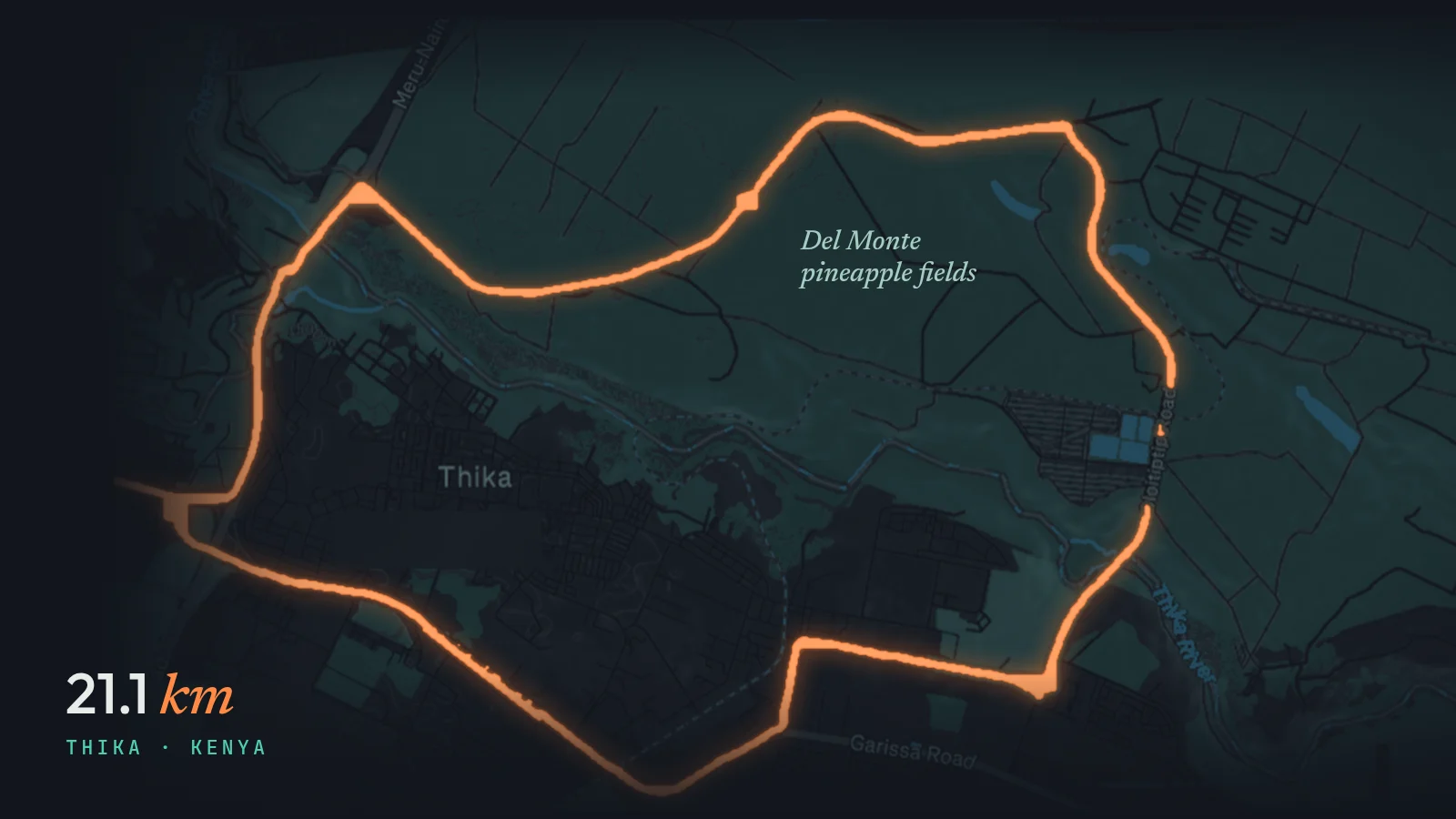
I recently covered 21 kilometres, the distance of a half marathon, and most of it ran through the Del Monte farm in Thika. If you have never been, picture this: pineapple fields stretching in neat green rows until they meet the mango orchards, Kilimambogo rising quietly in the distance, and the Chania river keeping you company as it rolls towards its falls. Apart from a few cars and a handful of Gen Z cyclists in bright jerseys, I had the tarmac almost to myself.
Long distances have never frightened me. I was born and raised in Kericho, where running was less a sport than a way of getting through the day. We ran across the tea bushes and through the forests to get to school and back, to fetch firewood, to go fishing, to play our games and to compete in school sports. Nobody called it training and nobody counted the kilometres. Those years gave me the legs for a half marathon. They also taught me to pay attention to the land under my feet.
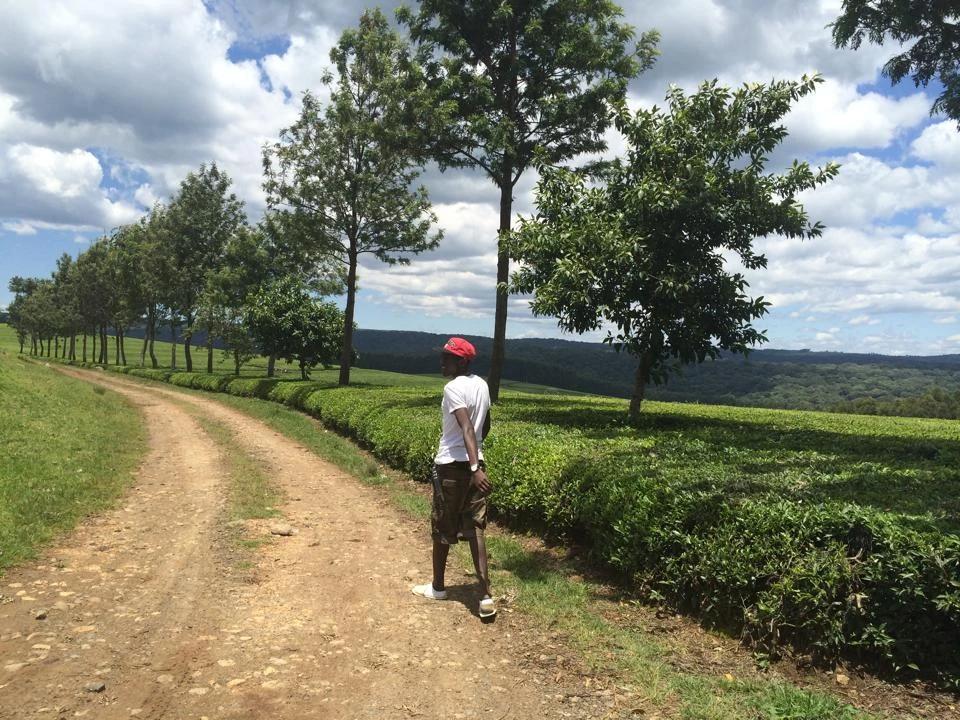
Photo: Harmon Okinyo, CC BY-SA 4.0, via Wikimedia Commons.
It is the kind of route that clears your head. And because my head was clear, I could not stop seeing what was lying beside the road.
What a keen eye sees#
We are used to talking about waste as a city problem. Nairobi has Dandora, a dumpsite that was declared full decades ago and still receives the city's rubbish. Pipeline Estate is notorious for heaps of garbage between the flats. These are the pictures that make the news.
But this was not Nairobi. This was a secluded road through a plantation, and still, every few metres, there was something that did not belong:
- Del Monte cans and Tetra Pak cartons, ironically within sight of the fields they came from.
- Metallic food platters, the kind used at roadside kibandas and functions.
- Plastic bottles, in every size, in the grass, in the ditches, wedged between rocks.
- Near Pioneer Girls, a mound of used baby diapers dumped beside the road.
- Outside Blue Post, a row of vibanda with waste scattered all around them.
Then there was the river. Under the bridge, a man was cooking. From the bedding and the pots, the space had clearly become someone's home. A little further downstream, a group of men were washing their clothes and bathing in the Chania. I mention them without judgement. People live where they can and wash where there is water. But it is worth remembering that the Chania flows on into the Thika and the Tana, rivers that millions of people downstream depend on, and that everything we drop on the land eventually finds its way into water like this.
The sugarcane problem#
On the way back I walked from BAT towards Thika Town. I bought sugarcane near BAT and ate it as I went, which is one of the small joys of walking in Kenya.
The walking path along that stretch has recently been renovated. It is wide and smooth and a genuine improvement. In the entire distance from BAT to town, I did not see a single dustbin.
So there I was, tired legs, sticky hands, a fistful of chewed sugarcane fibre and nowhere to put it. I carried it. Most people would not. And I understood, in a very physical way, how littering happens. It is rarely a decision to harm the environment. It is the path of least resistance when the right option is missing.
And the sugarcane? It came wrapped in a thin polythene bag. Kenya banned plastic carrier bags in August 2017, with some of the stiffest penalties in the world: fines of up to four million shillings or up to four years in jail. Yet nine years later, a vendor near a major factory could hand me sugarcane in exactly the bag the law outlawed. Somewhere between the law and the roadside, the ban leaks.
What you smell before you see it#
Litter is the waste you can see. The worst of what I passed that day was the waste you smell first.
Around BAT and through the industrial zone, past Bidco and Kenya Vehicle Manufacturers, raw sewage was flowing freely in open drains beside the road. At the bridge between Makongeni and the Del Monte cannery, the smell of fresh sewage running into the river is impossible to miss. The same is true opposite New Palleah Miller, right next to the Astrol petrol station. The stench is choking, and it is not the stench of something old and forgotten. It is fresh, which means it is happening every day.
I cannot tell from the roadside where each stream starts: a burst sewer line, homes that were never connected, a business discharging what it should treat, or all of these at once. That is exactly the problem. Nobody walking past can tell, and nobody seems to be checking. Every one of those drains ends in the same place, the river, and from there the water flows on to farms, livestock and the towns downstream.
A sweet wrapper on the verge is ugly. Raw sewage in a river is a public health emergency we have learned to walk past with our noses covered. It brings cholera and typhoid within reach of anyone who drinks, washes or swims downstream, including the men I saw bathing in the Chania that same morning.
What is going right#
It would be unfair to describe that road only by what was wrong with it, because some things along it are going very right.
The stretch outside Kenblest and the companies around it stood out. The grass is trimmed, the road edges are clean, and there was no waste outside their premises. Walking past it after the drains felt like crossing into a different town. Nobody forced them to look after the public space beyond their gates. They chose to, and it shows what one well-run compound can do for an entire street.
Then there is the Affordable Housing Project. It is massive, with sites going up at several points along the stretch, and it is coming out nicely. It is not only the skyline that is changing. The low-cost neighbourhoods of Makongeni are getting a real facelift, and for the families who will live there, the change will be felt in daily life, not just seen from the road. It is hard to walk past without being impressed.
Both are a reminder that the problems I have described are not inevitable. Clean streets and decent neighbourhoods are already being built in Thika. The task is to make them the rule rather than the exception.
Waste is a personal problem before it is a policy failure#
It is easy to blame the county, and the county deserves some blame. But I have come to believe that waste management starts with the individual, and is then let down by policy, not the other way round.
My son is barely six. He knows that we do not throw litter out of the car. If he finishes a snack on the road, the wrapper stays in the car, and we dispose of it when we get home. Nobody had to pass a law for him to understand this. He learned it the way children learn everything: by watching what the adults around him do, and by being reminded.
The adults needed reminding too. For a long time, my wife and even my mother had the habit of tossing empty yoghurt cups out of the car window. It was not malice. It was just what people did. We talked about where those cups end up, how long plastic stays in the soil, and what it looks like when thousands of people make the same small choice on the same road. They changed. Today the cups come home with us.
If a six-year-old can learn this, and if a habit carried for decades can change after a few honest conversations, then the problem is not that Kenyans are incapable of keeping their country clean. The problem is that we have not yet made it normal.
How Rwanda did it#
Every conversation about clean streets in East Africa eventually arrives at Kigali, and for good reason. Rwanda is not cleaner because Rwandans were born tidier than the rest of us. It is cleaner because the country made a set of deliberate choices and enforced them for years.
It banned plastic bags early and meant it. Rwanda outlawed non-biodegradable plastic bags in 2008, almost a decade before Kenya, and widened the ban to most single-use plastic items in 2019. Bags are checked at the border, and travellers arriving at Kigali airport are asked to give them up. The ban was enforced at the point where plastic enters the country, not only on the street vendor at the end of the chain.
It made cleaning a shared civic duty. On the last Saturday of every month, Rwandans take part in Umuganda, a morning of community work. Neighbours clear drains, sweep streets and fix shared spaces together, and then hold a community meeting. The practical result is cleaner neighbourhoods. The deeper result is that a clean street becomes something you helped make, and something you are less willing to see spoiled.
It gave the rules a face. Local leaders are held accountable for the state of their areas, and residents know that littering will be noticed and corrected. The rules are not hidden in a gazette notice. They are part of daily life.
It offered alternatives. A ban only works if there is something to use instead. Paper bags, woven bags and reusable packaging filled the gap, and many of them are made locally.
Rwanda is a smaller country with a different political culture, and not everything it does would or should be copied in Kenya. But the lesson that travels is simple: consistency beats intensity. A law enforced every day at the source does more than a harsh law enforced once a year on whoever happens to be caught.
What Kenya can do#
Kenya is not starting from zero. Beyond the 2017 bag ban, single-use plastics were banned from national parks, beaches and other protected areas in 2020. The Sustainable Waste Management Act of 2022 requires waste to be separated at source, and the Extended Producer Responsibility regulations make companies responsible for the packaging they put on the market. On paper, we have a decent framework. The gap is between the paper and the roadside. Here is how I think we close it, from the household up.
For every household#
- Keep a bag in the car. A single small bin bag behind the seat ends roadside littering for an entire family. This is what we did, and it works.
- Teach children, then let them teach you. Children are excellent enforcers. Once my son knew the rule, he reminded everyone else, grandmother included.
- Carry your own bag and decline plastic. When a vendor reaches for a polythene bag, say no and use your own. Every refusal is a small vote for the ban.
- Separate at home. Keep organic waste apart from plastics, glass and metal. It is already the law, it makes recycling possible, and organic waste can feed a small compost pit or kitchen garden.
- Deal with diapers properly. Used diapers should be wrapped and handed to a waste collector, not dumped by the road or in rivers. Parents who face a lack of collection services should press their county for one, because this is a public health issue, not only an eyesore.
For Thika#
- Put bins where people walk. The renovated BAT to Thika Town path is exactly where a few well-placed, regularly emptied bins would make an immediate difference. Building a walkway without bins is building half a walkway.
- Protect the Chania. Mark the riparian land along the river, clear the dumping spots near bridges, and work with social services to find better options for people living under them, instead of simply chasing them away.
- Hold the big names to their own packaging. Del Monte cans and cartons along Del Monte's own roads are a strong case for the Extended Producer Responsibility rules. Producers can fund collection points, recycling drives and clean-up crews along the routes where their products are consumed.
- Organise the vibanda. Roadside traders near spots like Blue Post need shared bins and a scheduled collection. Make a clean stall a condition for trading licences, and support traders to meet it.
- Close the open drains. Trace every sewage outflow around the industrial zone, Makongeni and the river bridges back to its source, then fix it: repair the sewer lines, connect the homes and estates that were never connected, and cover the open drains that run beside walkways. The county, the Thika water and sewerage company, NEMA and the Water Resources Authority each own part of this. Residents should be able to see who owns each drain.
- Test the water and publish the results. Sample the Chania and the Thika above and below the industrial zone every month and put the results online. Any factory upstream of a bad reading should be able to show that its effluent is treated to standard. Those that cannot should face the penalties the law already provides.
- Let companies adopt a stretch. What Kenblest and its neighbours do outside their gates should become a formal programme: each company along the highway and the industrial zone adopts the road, verge and drains in front of it, with its name on a sign so residents know whom to thank, or whom to call.
- Build the new estates complete. The Affordable Housing sites in Makongeni and along the stretch are the best chance in a generation to get this right from the start. Every block should open with working sewer connections, sorting bins and a scheduled waste collection, so the new neighbourhoods never inherit the old problems.
For Nairobi#
- Fix collection before blaming residents. Many estates litter because collection is unreliable. Predictable, scheduled pickups, published by ward, would remove much of the excuse.
- Formalise the people already doing the work. Waste pickers and youth groups recover a large share of Nairobi's recyclables. Registering them, equipping them and paying them through recycling contracts turns an informal survival job into a public service.
- Close the dumpsite story. Dandora has been full for decades. The city needs a properly engineered sanitary landfill and sorting stations, so that separation at source has somewhere to go.
- Get sewage out of the rivers. The Nairobi River will not be clean until the sewage that drains into it is caught and treated. Extend sewer lines into informal settlements, maintain the treatment works so they actually run, and keep riparian land clear so drains cannot hide along the banks.
- Enforce visibly and fairly. County officers who fine littering in the CBD, in matatus and at stages, consistently and without extortion, will change behaviour faster than any campaign.
For the country#
- Stop the bags at the source. The polythene bag that wrapped my sugarcane came from somewhere. Enforcement should focus on manufacturers, importers and border smuggling routes, where a single seizure removes millions of bags, rather than on the hawker at the end of the chain.
- Bring a monthly clean-up day into the national calendar. Kenya has held national clean-up days before. Make it regular, local and led by chiefs, ward administrators and schools, so it becomes habit rather than a photo opportunity.
- Pay for bottles and cans. A deposit-return scheme, where you get a few shillings back for every bottle or can returned, has cleaned up roadsides in many countries. Once a can has value, it does not stay in the ditch for long.
- Teach it in school. Waste and conservation should be practical lessons in the CBC curriculum: sorting, composting, and clean-ups around the school. My son learned the rule at home. Every child should learn it somewhere.
- Treat sewage as waste too. Most Kenyan towns have far more people than sewer connections. National funding for sewer networks and treatment plants deserves the same urgency as roads, because a road that runs beside an open drain is not finished.
- Publish the numbers. Counties should report how much waste they collect, recycle and send to landfill, and how much sewage they treat, every year. What gets measured gets managed, and what gets published gets debated.
The road back#
I finished my 21 kilometres tired, sticky and a little angry, but mostly hopeful. The Del Monte farm is still beautiful. Kilimambogo is still standing over the plains. The Chania still runs. None of what I saw is permanent, and none of it requires a miracle to fix.
It requires a bin on a walkway, a drain that is closed and connected, a bag in a car, a vendor who is told "no thank you", a county that collects on schedule, and a country that enforces the laws it has already written. Rwanda did not get clean in a day. It got clean one Saturday at a time.
So here is my ask. The next time you finish a yoghurt in the car, or a bottle of water on a walk, or a stick of sugarcane on the road from BAT, keep it until you find a bin. If there is no bin, carry it home. And then tell your county that there should have been one.